
Engels’ pause: who wins this time?
Engels’ pause: who wins this time?
Whilst attention is naturally focussed on the changing tides around the Strait of Hormuz and the tensions between Iran, the US and Israel, this week we take a step back and reflect on Artificial Intelligence (AI) and its historical precedents.
A close historical parallel to today’s environment could be Engels’ Pause, which occurred during the First Industrial Revolution and is termed after the social theorist Friedrich Engels, who documented the hardships faced by workers. With Artorius’s Manchester heritage, we note the presence of his statue only yards from our office as testament to his work in the 1840s.
The Engels’ Pause lasted around 50 years (1790-1840) and began nearly 80 years after the first commercially successful steam engine was introduced in 1712. While steam power drove substantial gains in output and productivity, it took almost a century for those benefits to diffuse meaningfully across the wider economy.
At its core, the pause reflected the unequal distribution of gains: rising corporate profits were not shared evenly across labour, with the rewards accruing largely to owners of capital - mill and factory proprietors, landowners, and holders of infrastructure and patents - who reinvested to expand industrial capacity. Labour was plentiful and had little negotiating power, with workers’ rights effectively non-existent and real wages falling.
Crucially, this deterioration in living standards occurred against a backdrop of broadly falling prices, as illustrated in the chart below. The period spanning Engels’ Pause is characterised by episodes of deflation, highlighting a key dynamic. Even as the cost of many goods declined, the benefits of rising productivity failed to reach workers. In simple terms, although things were getting cheaper, workers were not earning enough to feel better off - a reminder that lower prices alone do not deliver broad-based prosperity when incomes are not rising.
Inflation through the industrial lens
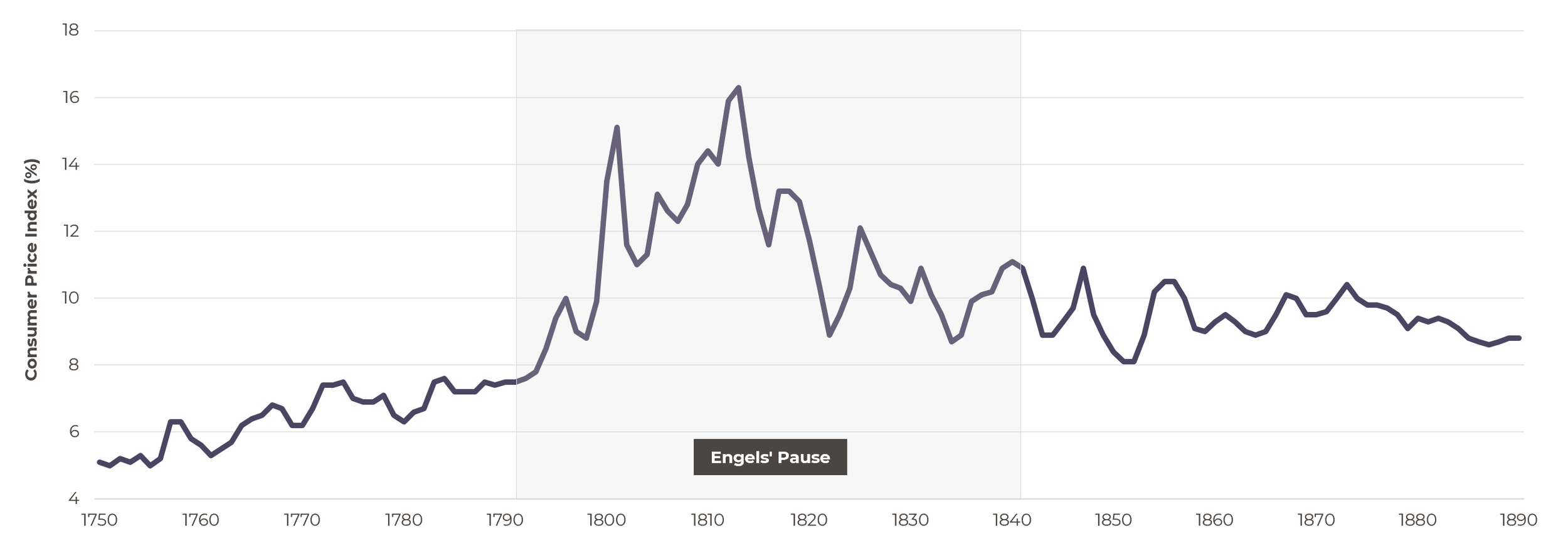
Source: Artorius, House of Commons (Contains Parliamentary information licensed under the Open Parliament Licence v3.0).
All to play for
History may be ringing a familiar bell. Engels’ Pause reminds us that periods of rapid technological progress can leave segments of the workforce behind when the gains are unevenly distributed. Today, computer servers and algorithms may be the modern equivalent of the steam engine - powerful, productivity-enhancing technologies that are relatively concentrated within a small number of firms. While competition and innovation remain dynamic, there is a risk that scale advantages in data, computing power and talent could reinforce the position of leading players over time.
One possible outcome is a world in which a handful of large technology firms exert significant influence, not only within their own sector, but across a growing range of industries as digital capabilities become more deeply embedded in the economy. However, this does not imply a wholesale replacement of workers. Rather, the impact is likely to be uneven. Some roles, particularly routine or repetitive tasks, may be displaced, while others are reshaped or augmented. Highly skilled workers are not confined to the technology sector, and many roles across healthcare, education, engineering and services are likely to remain both relevant and difficult to automate.
Even so, the transition may prove disruptive. The benefits of AI could accrue disproportionately to those with the skills to work alongside it, as well as to firms that own and deploy the technology, raising the risk of widening inequality. It is this uncertainty, rather than a clear-cut outcome, that is increasingly reflected in worker sentiment. As shown in the chart below, a meaningful share of US workers over the last few years express concern about the potential for automation to affect their jobs. This highlights the perceived risks of technological change are already influencing behaviour and expectations today.
How worried are US workers about their jobs being automated?
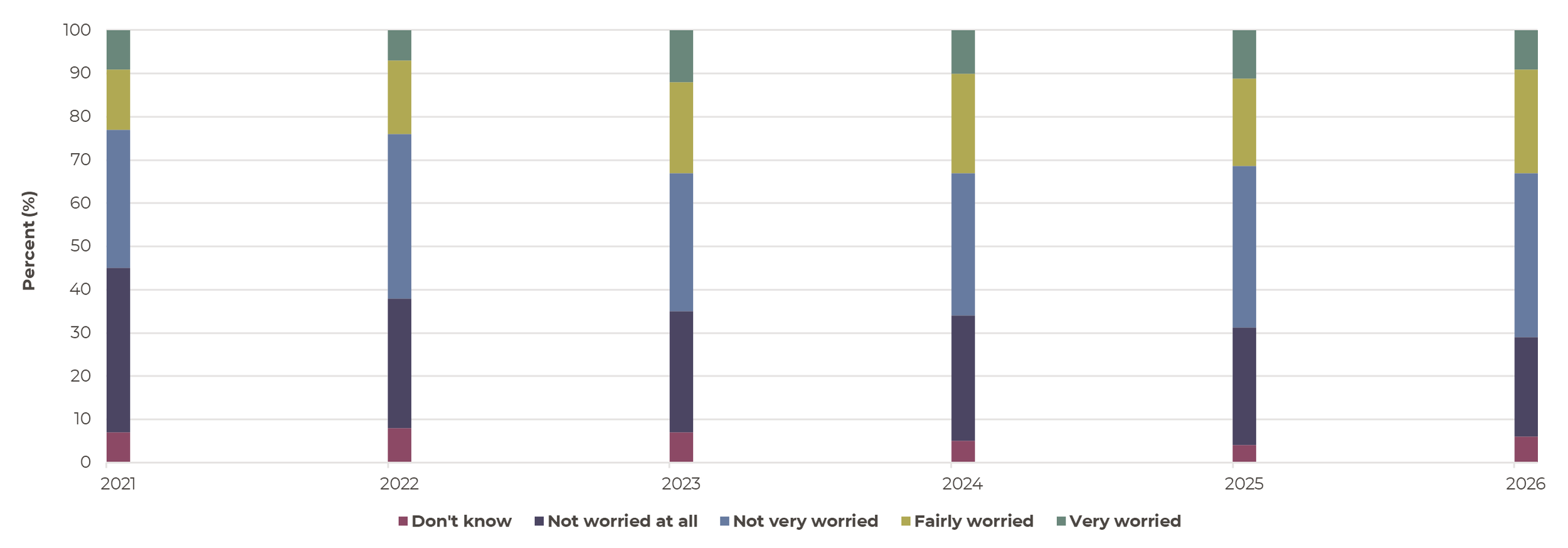
Source: Artorius, YouGov (2026) – with minor processing by Our World in Data. YouGov, “How worried are Americans about being automated out of a job?” [original data]
A different ending?
An alternative scenario - and one towards which some economies may already be drifting - is a more state-led approach to the ownership and deployment of data, algorithms and production. In this model, AI is used not primarily to enhance individual productivity or corporate profitability, but to manage and optimise the allocation of labour and capital at a broader societal level.
While such an approach may help to reduce inequality, historical experience with more centrally controlled systems suggests it can come at a meaningful cost. This potentially includes uneven living standards, weaker incentives for innovation, and ultimately lower overall economic dynamism. The trade-off, in effect, is between greater control and coordination on the one hand, and flexibility and innovation on the other.
The way AI is developed and deployed is unlikely to be uniform across countries. Different political systems, regulatory frameworks and social priorities will shape outcomes in distinct ways - ranging from more market-led models to more state-directed approaches. These differences can already be seen in how individuals perceive the future impact of AI.
Expectations diverge significantly across income groups at a global level. Higher-income cohorts tend to be more optimistic about the benefits of AI, while lower-income groups express a greater concern about its potential impact. This gap in sentiment may partly reflect differing levels of exposure to disruption, but also highlights how the distribution of AI’s gains, both within and across countries, will be central to determining whether the technology is ultimately seen as a force for broad-based prosperity or increased inequality.
Two global views of the same future: The impact of AI over the next 20 years
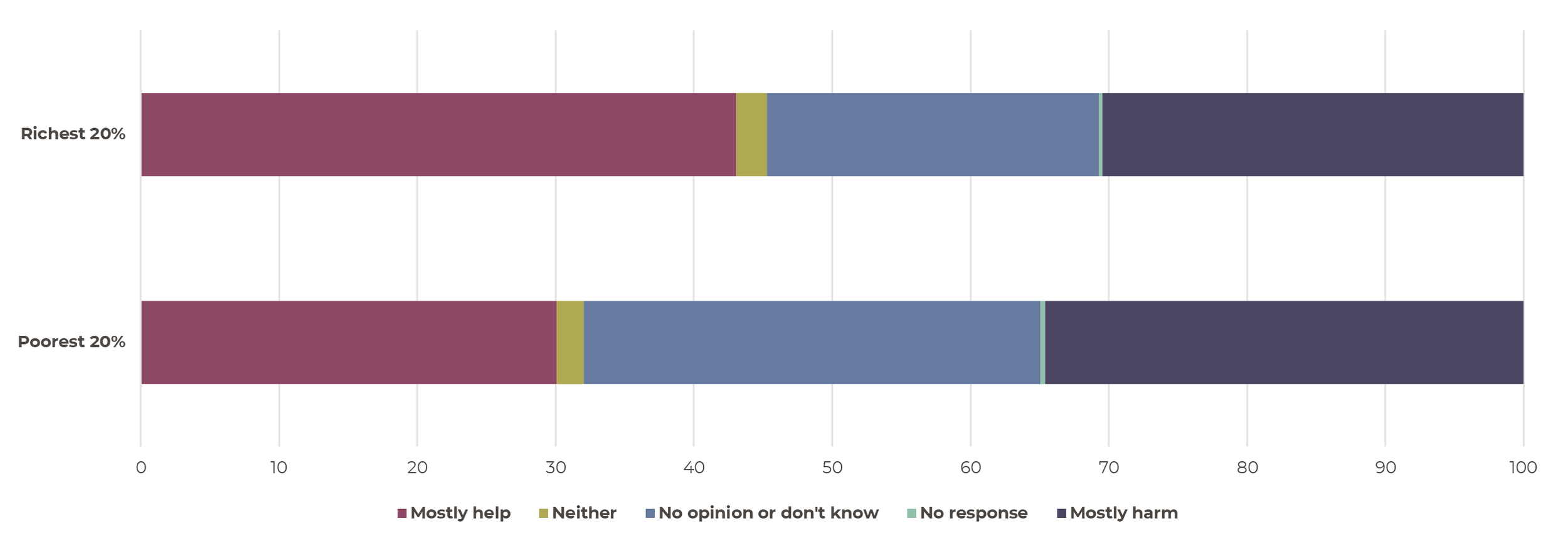
Source: Artorius, Lloyd's Register Foundation (2022) – processed by Our World in Data. Lloyd's Register Foundation (2022) [original data].
Designing the future of work
AI is no longer a future prospect as it is already being deployed across industries and is beginning to reshape how work is done. The more relevant question is not whether AI will have an impact, but how that impact is distributed. For Western democracies, the most plausible path is one in which AI continues to be widely adopted with outcomes shaped more deliberately rather than left to chance. This is likely to require a modernisation of antitrust frameworks and the introduction of clear guardrails governing its use. Such an approach recognises, and seeks to avoid, the so-called lump of labour fallacy. This fallacy assumes that there is a fixed amount of work in the economy and, therefore, a finite number of jobs. Under this view, new technologies or increases in labour supply simply displace existing workers, reducing opportunities for others.
In practice, while technological change and globalisation can be highly disruptive in the short term, labour markets have consistently demonstrated an ability to adapt. New industries and entirely new roles continue to emerge - from drone operators and robotics engineers to content creators and digital specialists - reflecting the dynamic nature of modern economies.
This adaptability is illustrated by the experience of Geoffrey Hinton, often described as a pioneer of AI, who in 2016 suggested that advances in machine learning would soon render radiologists largely obsolete. In reality, the opposite has occurred and the number of radiologists has continued to rise, with the profession evolving to incorporate AI as a complementary tool, enhancing productivity and enabling greater specialisation.
Design, not destiny: Choosing the path forward
A modern-day Engels’ Pause is not an inevitable outcome of the AI revolution, but a function of the collective choices made today. History demonstrates that technological breakthroughs can give rise to prolonged periods of stagnation and inequality when productivity gains accrue primarily to owners of capital rather than labour. Given its capacity to substitute for both physical and cognitive tasks, AI presents a clear risk that such a dynamic could re-emerge.
How policymakers react to the emergence of AI may determine the impact of AI on employment and wider society. Engels’ Pause ended when gains finally spread, as new industries created better-paying jobs, skills improved and living standards rose. In this context, whether AI delivers broad-based prosperity or a renewed Engels’ Pause will ultimately depend on design, not destiny. This will have important implications for investors, from the distribution of corporate profits to the trajectory of wages, productivity and long-term economic growth.
Mark Christie
Investment Analyst

*Any feedback provided can be anonymous
Important Information
All expressions of opinion reflect the judgment of Artorius at 24th April 2026 and are subject to change, without notice. Information has been obtained from sources considered reliable, but we do not guarantee that the foregoing report is accurate or complete; we do not accept any liability for any errors or omissions, nor for any actions taken based on its content. The value of an investment and the income from it could go down as well as up. The return at the end of the investment period is not guaranteed and you may get back less than you originally invested. Past performance is not a reliable indicator of future results. Nothing in this document is intended to be, or should be construed as, regulated advice. Artorius provides this document in good faith and for information purposes only. Reliance should not be placed on the information contained within this document when taking individual investments or strategic decisions.
Artorius Wealth Management Limited is authorised and regulated by the Financial Conduct Authority. Artorius is a trading name of Artorius Wealth Management Limited.
FP20260424001