
A paltry article?
A paltry article?
Yes, that is an awful attempt at a pun on poultry and paltry being vaguely similar, and no, this article’s ceiling probably isn’t getting any higher than that. But as we sit between Thanksgiving in the US and the Christmas holiday period, there is no better time to write a light-hearted article on turkeys and a weird and wonderful correlation: the price of turkeys in the US and stock market performance.
The price of turkeys sold in the US shows correlation with the return of world equities (RHS – right hand side)
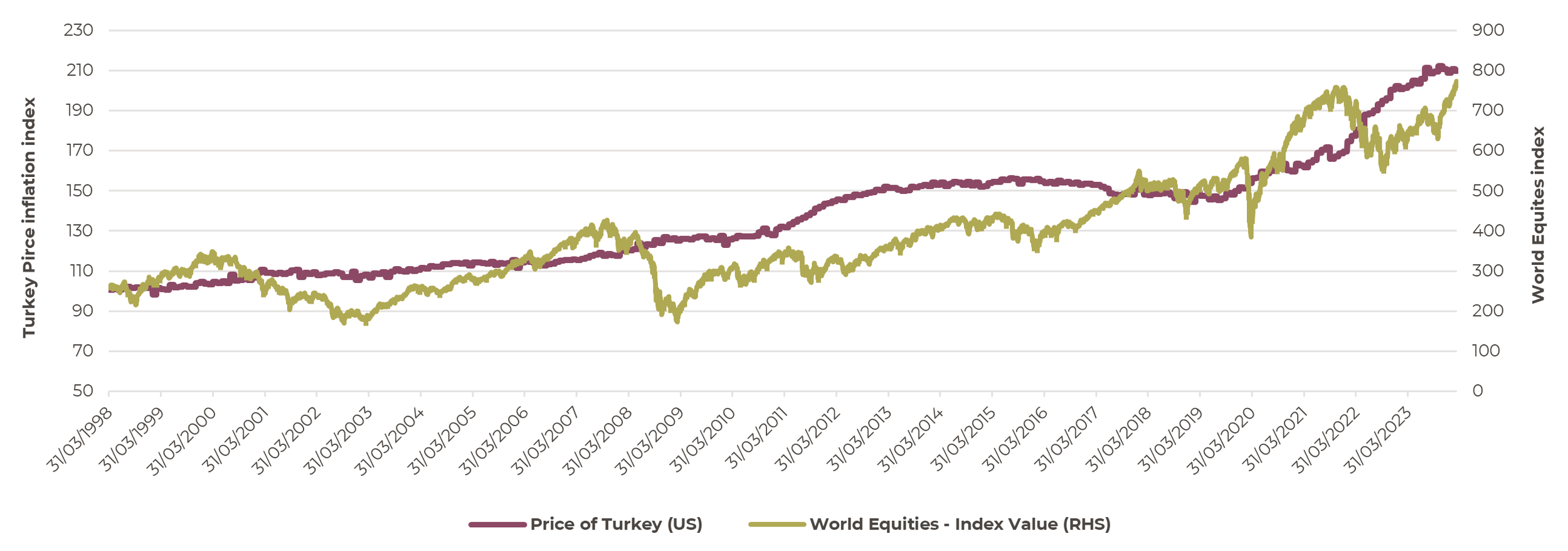
Source: Bloomberg, Artorius
MSCI ACWI used as the world equity index
The Hypothesis: Expensive Birds, Bullish Markets?
This utterly unscientific, yet delightfully absurd, theory operates on a simple principle: Consumer confidence and economic optimism.
If the average turkey price is up, it suggests demand is robust. Consumers are willing to host larger dinners and splurge on a more expensive option, suggesting a robust economy. Conversely, if the average price is down, it suggests budgets are stretched; families opt for smaller or cheaper, value-friendly options. This belt-tightening would signal a bearish trend, with the market in the doldrums.
It’s the Farmers, Not the Financiers
In reality, we can, with fairly strong confidence, say: There is probably no demonstrable correlation or causation.
Stock markets are, in reality, driven by interest rate decisions, global trade winds, and company earnings. The turkey’s price, conversely, is primarily influenced by one factor that completely invalidates the hypothesis: agricultural science. The average weight of a turkey has more than doubled in the last 50 years; due to an increased cost in farming, coupled with general inflation, the price rises are understandable.
Turkey size is on a decades-long trajectory to becoming gargantuan, driven by selective breeding, not the state of your investments. The sheer scale of this increase, completely separate from the stock market's short and long-term movements, is the ultimate proof that the perceived correlation is merely a delicious distraction.
The Lure of the Quirky Indicator
The financial world, however, loves a quirky indicator. From the "Big Mac Index" (an informal guide to currency valuation based on the price of a McDonald's Big Mac in different countries) and the "Skyscraper Index" (the completion of the world’s tallest building precedes an economic downturn) to "Santa Rallies" (a tendency for stock markets to rise in the last few trading days of December and the first few trading days of January)—only one of those has already been written about in an Investment Comment, so that is my next two years of December writings lined up already!
The weight and price of a turkey joins this list not for its predictive power, but for its delightful, temporary light-hearted relief. In reality, a few crucial, common-sense principles are more important than looking for correlation in strange places:
Patience: Whether you’re waiting for a special dinner to be perfectly cooked in the oven or for your investment returns to materialise, patience is essential. In investments, a sensible long-term horizon is key. Trying to time the market or reacting to every minor dip is incredibly challenging. Consistent investment over time is often the most successful strategy.
Diversification: Just as a Christmas dinner needs variety (for example: turkey, potatoes, stuffing, vegetables) to be satisfying, so does an investment portfolio. Diversification means not putting all your money into one stock, one industry, or one asset class. Spreading your investments helps to reduce the overall risk, because when one asset performs poorly, others may be performing well, leading to more consistent returns.
In summary, big poultry is just that—bigger than it was several decades ago. Although its size has increased, there isn't a conspiracy theory here about turkey farmers controlling the stock markets. The key takeaway is this: Sometimes, a big turkey is just a big turkey, and sometimes, the market just goes up or down regardless of the weight of your Christmas or Thanksgiving meal.
Josh Young de Ferrer
Portfolio Manager

*Any feedback provided can be anonymous
Important Information
All expressions of opinion reflect the judgment of Artorius at 12th December 2025 and are subject to change, without notice. Information has been obtained from sources considered reliable, but we do not guarantee that the foregoing report is accurate or complete; we do not accept any liability for any errors or omissions, nor for any actions taken based on its content. The value of an investment and the income from it could go down as well as up. The return at the end of the investment period is not guaranteed and you may get back less than you originally invested. Past performance is not a reliable indicator of future results. Nothing in this document is intended to be, or should be construed as, regulated advice. Artorius provides this document in good faith and for information purposes only. Reliance should not be placed on the information contained within this document when taking individual investments or strategic decisions.
Artorius Wealth Management Limited is authorised and regulated by the Financial Conduct Authority. Artorius is a trading name of Artorius Wealth Management Limited.
FP20251212001